Introduction
Arabic is the fourth most spoken language on the internet and arguably one of the most difficult languages to create automated conversational experiences for, such as chatbots. An Arabic chatbot is a program that can understand and respond in Arabic.
Natural language technologies enabling us to simulate and process human conversations in Arabic have improved a lot over recent years. Enabling us to train to understand the emotions, and meanings, and detect the misspellings and sentiments of the language.
In this post, we wanted to take a look at the challenges, and available tools and create a brief proof-of-concept chatbot using one of these tools.
Arabic NLP Challenges
Arabic natural language processing (NLP) is a rapidly growing field, but it also presents a number of unique challenges compared to other languages.
- Sparsity of Data: One of the biggest challenges facing Arabic NLP is the lack of large-scale, labeled datasets. This makes it difficult to train accurate models and leads to low performance on certain tasks.
- Complex Script: Arabic script is complex and includes many diacritics and ligatures, which can make text pre-processing and feature extraction more difficult.
- Morphological Complexity: Arabic has a complex morphological structure, which can make it difficult to accurately segment words and identify the root of a word. This can make tasks such as stemming and lemmatization more challenging.
- Language Variation: Arabic is spoken in many countries and dialects, which can lead to variations in vocabulary, grammar, and syntax. This can make it difficult to design models that are able to handle the diversity of the language.
- Annotation Challenges: Annotating text for NLP tasks is always a challenge, but it is even more so for Arabic due to the complexity of the language and the lack of resources.
- Right-to-Left Script: Arabic script is written from right to left, which can make it challenging to integrate with left-to-right script systems and can also affect text alignment and layout.
- Lack of Standardization: There are few standard resources for Arabic NLP, such as corpora, part-of-speech tag sets, and named entity recognition tags, which can make it difficult to compare results across different studies and to replicate previous work.
- Cultural and Religious Sensitivity: Arabic text may contain sensitive cultural and religious topics, which may require special consideration when processing and analyzing the data.
Despite these challenges, there is a lot of ongoing research and development in the field of Arabic NLP, and many organizations and researchers are working to overcome these obstacles. With the increasing demand for Arabic NLP in areas such as customer service, e-commerce, and social media, it is important to continue to invest in this field and develop solutions that can help organizations to better understand and engage with Arabic-speaking customers.
To conclude, Arabic NLP is challenging due to the complexity of Arabic script and grammar, the lack of data, and the diversity of the language.
Arabic Conversational AI Technologies
The NLP technologies include advanced machine learning algorithms, natural language understanding models, and language-specific libraries and tools which need to carry out the following tasks:
- Arabic Speech Recognition: This technology is used to convert spoken Arabic into text, which is then processed by the conversational AI system.
- Arabic Text-to-Speech: This technology is used to convert text-based input into spoken Arabic, allowing the chatbot or voice assistant to speak in the language.
- Arabic Natural Language Processing (NLP): This technology is used to understand and interpret the meaning of text written in Arabic. It includes techniques like tokenization, part-of-speech tagging, and sentiment analysis.
- Arabic Language Modeling: This technology is used to train machine learning models on large amounts of Arabic text, allowing them to understand and generate the language.
- Arabic Sentiment Analysis: This technology is used to determine the emotions and opinions expressed in Arabic text, which is useful for understanding customer feedback or gauging the effectiveness of marketing campaigns.
Technical Solutions
CAMeL Tools
CAMeL Tools is a suite of Arabic natural language processing tools developed by the CAMeL Lab at New York University Abu Dhabi.
The camel-tools package comes with a nifty 'morphological analyzer' which - in a nutshell - compares any word you give it to a morphological database (it comes with one built-in) and outputs a complete analysis of the possible forms and meanings of the word,
The tool will reduce orthographic ambiguity to account for several common spelling inconsistencies across dialects. Camel-tools accomplishes this by removing specific symbols from specific letters.
Repustate
The Repustate platform provides a number of natural language processing tools for analyzing Arabic dialects. It understands three major Arabic dialects - Gulf Peninsular, Egyptian, and Levantine Arabic also it Obtains granular Arabic emotion analysis by aspect rather than Visualize all the insights in a customer insights dashboard
Arabic natural language processing (Arabic NLP) powers the sentiment model, such that it differentiates between Arabic dialects while picking up on colloquialisms, language nuances, social media short forms, and even emojis.
Repustate enables you to quickly and accurately capture customer and employee sentiments to increase efficiency and improve customer experience, provides native language analysis for 23 languages, and makes social media listening effortless by seamlessly integrating with the world's most popular social networks, review sites, and news sources.
Watson NLU
IBM Watson is one of the most well-known conversational AI platforms.
IBM Watson Natural Language Understanding gives you access to detailed developer resources that help you get started fast, including documentation and SDKs on GitHub.
The Arabic Natural Language Understanding enables users to extract meaning and metadata from unstructured text data. Text analytics can be used to extract categories, classifications, entities, keywords, sentiment, emotion, relationships, and syntax from your data.
Some high-level features of the platform
- Train Watson to understand the language of your business and extract customized insights with Watson Knowledge Studio.
- Surface real-time actionable insights to provide your employees with the tools they need to pull meta-data and patterns from massive troves of data.
- Deploy Watson Natural Language Understanding behind your firewall or on any cloud.
There are some Arabic language limitations, some features are not supported in Arabic such as classifications, concepts, emotions, and semantic roles for these features.
Azure Cognitive Service
Azure Cognitive Service for Language is a new cloud-based service that provides NLP features for understanding and analyzing text.
This language service unifies Text Analytics, QnA Maker, and LUIS and provides several new features.
Most importantly it supports 96 languages including Arabic.
You can create an FAQ bot trained on unstructured data or use this to create advanced conversational experiences with the Microsoft Bot Framework.
Other Options
This is not an exhaustive list. There are many other Arabic NLP options out there (e.g Farasa, MADAMIRA, and Stanford (CoreNLP)
Botpress

Botpress is a favourite of ours as it's an all-in-one conversational AI platform.
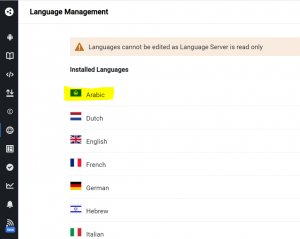
Most importantly for this post is that the Botpress natural language understanding engine also provides Arabic natural language understanding out of the box.